
Steam, Shells, and Half-Chickens: The Delicious Contradiction of the Cleveland Clambake
How landlocked Northeast Ohio hijacked an Atlantic shore staple to become America’s unlikeliest autumn clam capital
By Eric Gibson
September 17, 2026
A Quick Note: Every stop, pick, and dish on Vittles & Nosh is independently chosen by us. While we may earn a small affiliate commission if you purchase through our links, it never costs you a dime.
It’s fall. We’ve made it back around again.
The leaves have started turning. The air has gone crisp. The days are a little shorter. Football is back on primetime, and pumpkin ales line the shelves. It’s arguably the best food season of the year with the return of hearty autumn foods like chili (as if we ever stopped cooking it) and the Cleveland Clambake.
Wait. Clambakes? In Cleveland? Surely that’s a misprint. A typo. Some twisted midwestern euphemism.
No, you read it right. Cleveland, Ohio—a city parked on the southern rim of Lake Erie, sitting comfortably more than 400 miles from the nearest ocean. Yet every September, Cleveland becomes a crustacean-cracking, bivalve-slurping seafood town that rivals coastal hotspots in Maine and Rhode Island.
It’s a tradition we wait for all year long, and during an eight-week stretch from late September through November, the region inhales millions of clams and drawn butter.
To understand why, we first have to clear up a massive culinary identity crisis.
The Great Deception: Bakes vs. Boils vs. Steams
You are probably familiar with a low-country boil. There is a non-zero chance you’ve stood elbow-to-elbow around a newspaper-lined table while pounds of shrimp, crawfish, sweet corn, redskin potatoes, and andouille sausage are dumped straight from the pot and washed down with cold lager.
We can smell the Old Bay from here.
A boil, however, is not a bake. And even more bewildering: the Cleveland clambake isn’t a bake, either.
The New England Clambake: An Actual Beach Bake
Along the Atlantic coast, from Maine down through Rhode Island, New Englanders have perfected the summer sand-pit feast. An authentic coastal clambake is essentially an earth oven. Think a pig roast, but with shellfish.
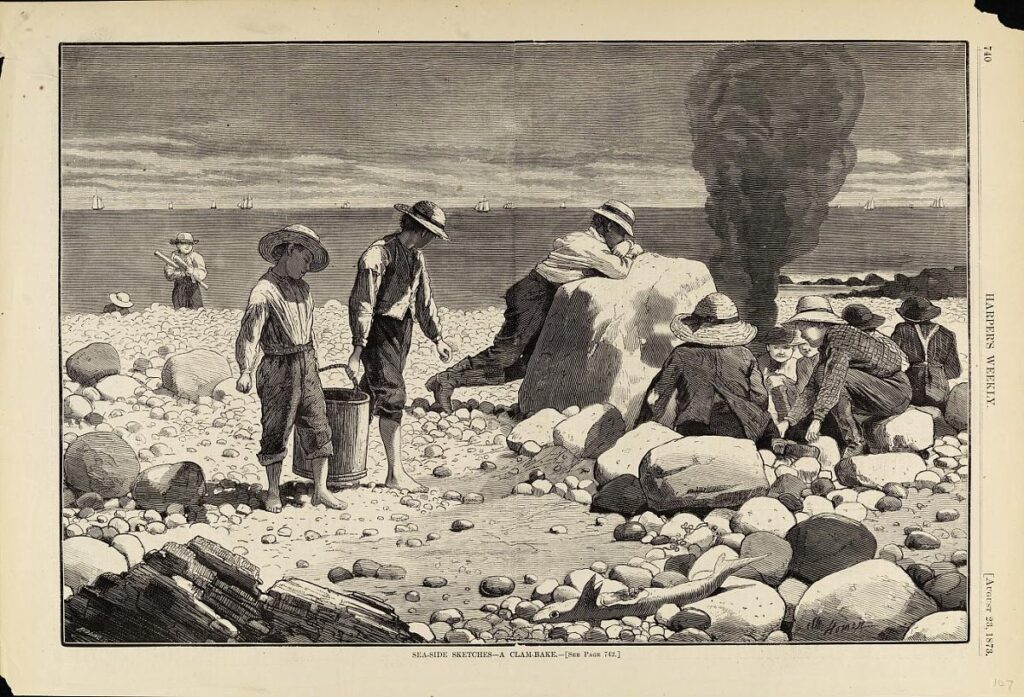
Feasters dig a massive pit right into the sand, line it with rockweed plucked wet from the nearby surf, and build a blazing fire directly over round stones gathered from the shore. Once the fire burns down and the rocks are blisteringly hot, the ashes are swept aside and covered with another thick blanket of seaweed.
Then the fun begins.
Layers of softshell clams, lobsters, unhusked sweet corn, and potatoes are stacked on top, covered with more steaming weed, capped with sea-soaked burlap sacks, and buried. For hours, the ingredients bake. We drink and get merry. When stripped open, briny steam, roasted corn husks, and sweet shellfish fill the air. It’s rugged, a whole lot of work, but authentically New England.
“The Cleveland clambake is a glorious culinary contradiction: half New England shore dinner, half church-basement chicken dinner, and 100% steamed on a back patio.”
The Cleveland Style: All Boil, Zero Sand
The Cleveland dish shares most of the name and none of the methodology.
You will find no sand pits on Edgewater Beach, no seaweed, and no wood coals.
In Cleveland, they put a steamer pot atop a roaring burner, preferably outside. Water, beer, or clam nectar fills the bottom, and the feast is steamed under a tight lid until the shells open wide.
But let’s be real, the ingredients stop resembling New England style almost immediately. A genuine Cleveland clambake plate looks a little like half of that New England shore dinner and half a church-basement chicken dinner.
Steamed on the back patio.
The ingredients are thrown in a pot, low country style, and steamed until cooked through. It stops resembling a low country boil after that. There’s never lobster or crawfish, and only rarely crab. Just several dozen clams.
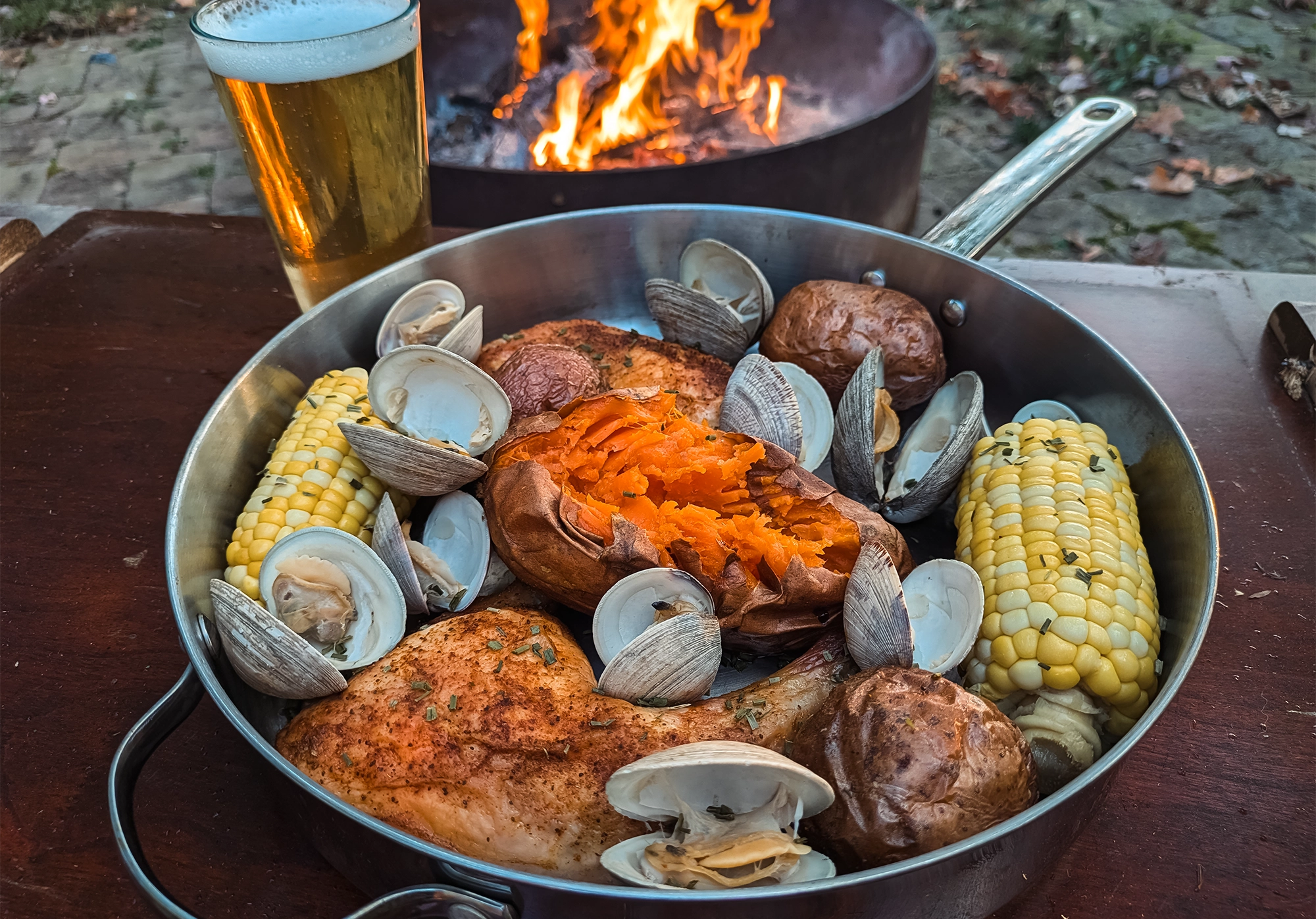
What it does have, traditionally, is a half chicken, a sweet potato, middleneck clams, and corn on the cob. On the side are dinner rolls and a hearty bowl of clam chowder.
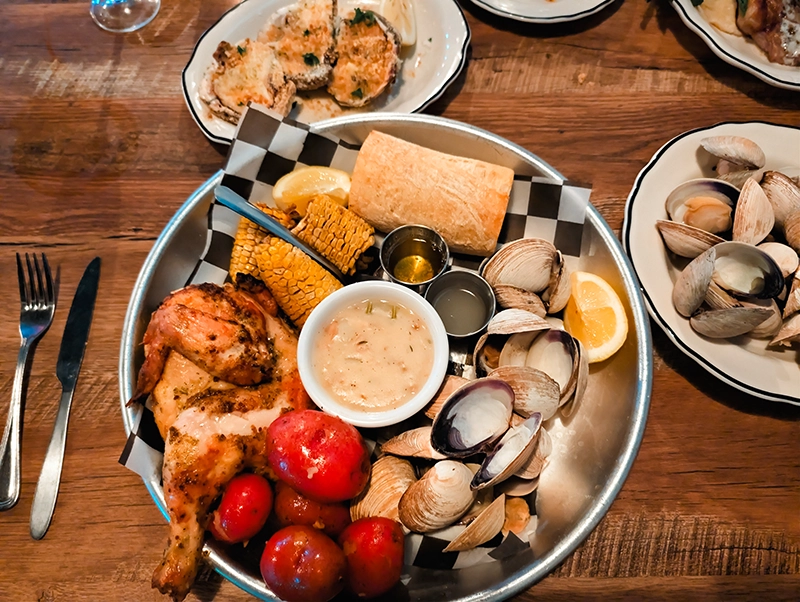
It’s how they did it for the last two centuries and it’s how we’re still doing it today.
The Euclid Fish Company says to throw all the ingredients onto a giant steamer basket in a massive pot. Chicken, corn, clams and all. Cook it with just enough juice and water to steam without going dry, and once everything is to temp, serve it boil style.
We get it now.
But none of this explains how or why this particular style of clambake is truly the Cleveland thing. Before we set to making our own we need to know why.
The simple explanation? Rich people.
Connecticut Roots and Rockefeller Trains
As we’ve said, Cleveland sits on the shore of a Great Lake that is a very very long ride to the sea. Fresh clams just aren’t plucked from the nearby waters.
Thankfully.
They must be flown in, shipped in, shuffled or smuggled in, and that takes a lot of effort just for another excuse to eat in a city already full of excuses to eat. (We’re talkin’ fish fries to paczkis, Polish fests, the Feast of the Assumption… the Land is always eating).
Before Ohio achieved statehood in 1803, and long before Cleveland dropped the second ‘a’ from its name, the young colony of Connecticut held a royal land charter granting it territory stretching all the way west to the Pacific Ocean. When the smoke cleared from the Revolutionary War, Connecticut still retained a 120-mile-wide strip south of Lake Erie, officially designating it the “Western Reserve” of Connecticut.
On one side of this land was a half-million acres designated for families who lost their homes in the British invasion during the Revolutionary War. These were the “Sufferer’s Lands.” While most just up and sold off their gifted properties, some settled.
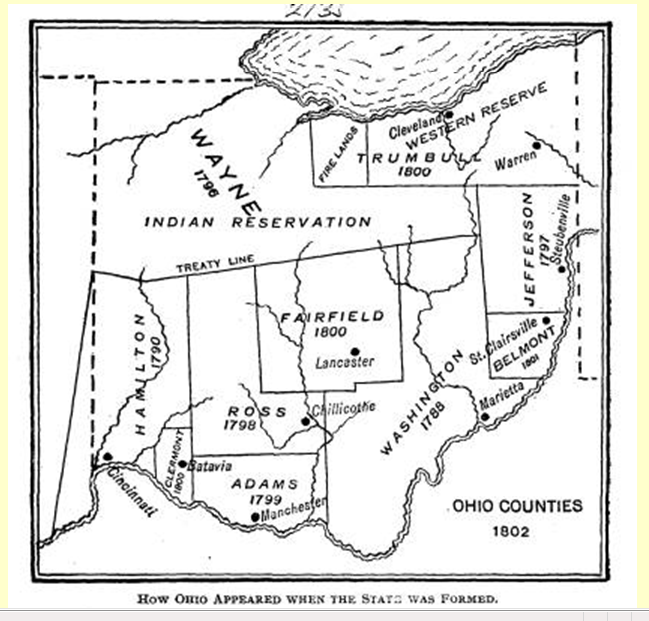
After the war The Connecticut Land Company laid claim to millions of acres, politely ignoring who was already living there, and sent surveyor Moses Cleaveland west to carve up the wilderness into tidy New England townships, laying out a classic 10-acre Public Square at the mouth of the Cuyahoga River. Spoiler alert, Public Square still exists in downtown CLE.
Along with those Connecticut blueprints, the early settlers brought their Atlantic palates and holiday traditions with them.
Enter John D. Rockefeller
Settlers loved seafood, but keeping ocean shellfish alive in the frontier era was nearly impossible. Lake Erie was abundant with perch and walleye, but salty bivalves remained a distant luxury.
Then came the Industrial Revolution, the rise of the railroads, and the birth of refrigerated ice railcars. In the late 1800s, Cleveland wasn’t just another stop along the line; it was the capital of American corporate wealth. It was the home of Standard Oil and Millionaires’ Row.
Chief among these gilded titans was John D. Rockefeller. When fall arrived, Rockefeller would throw lavish, legendary autumn harvest parties at his Forest Hill estate in East Cleveland.
And boy did he.
Rockefeller’s parties were meant to be over the top. He didn’t just bring the food, he brought barrels of live Atlantic clams packed in salt-hay ice wagons rushed in by train along his own rail lines just to show off. He brought the food, and the well to do in the area threw down with him. His parties were epic. According to legend those parties were clambakes. The Cleveland way.
Rockefeller didn’t just eat clams; he threw clambakes that were the networking events of America.
The local industrial elite took note, the neighborhood clubs adapted the tradition, and Euclid Fish Company began packaging DIY kits in the 1940s. What began as an oil baron’s coastal flex evolved over the next century into the ultimate autumn ritual across the West Side, East Side, and everywhere in between.
Whether it is true or not, the real mystery is how Cleveland has rocketed to become the biggest consumer of seafood from September through November in the country. Still. It may have been a thing before ol’ John D came to town. Even before Moses Cleaveland had a town named after him.
Could the Erie people have invented the Cleveland clambake? We may never know.
So let’s throw a Rockefeller party.
How to Steam Like a Clevelander
For research, we had to have ourselves a clambake. Several actually.
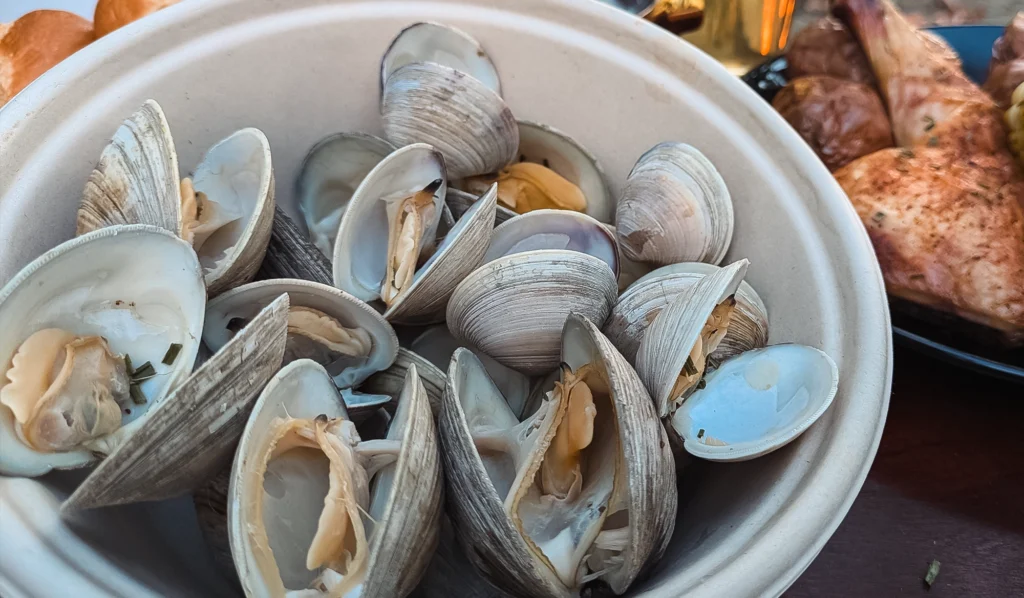
The definitive CLE clambake is an identity crisis on butcher paper.
- One dozen steamed middleneck clams (served in broth with melted butter).
- A roasted half chicken (or chicken quarter).
- Sweet corn on the cob. (Szalay’s is the best corn in the universe.)
- A whole sweet potato (or baked potatoes).
- A cup of clam chowder.
- A crusty dinner roll.
It must be noted that if someone serves this without the chicken or chowder, they are legally liable for a civic disturbance.
The process is straightforward, but the layering order matters:
- Build the Base: Fill the bottom two to three inches of a heavy big steamer pot or kettle, the larger the better. Add water, a cup of white wine or crisp pilsner, garlic cloves, a few lemon halves, and a heavy hand of Old Bay seasoning.
- Stack it Up: Set the perforated steamer basket in place if you have one, or use the the dense root vegetables like sweet potatoes (the classic), whole onions, and redskin potatoes if yams aren’t your thing.
- The Middle Deck: Layer the sweet corn on the cob (husked or in-husk) and the seasoned half-chickens. (Tip: While traditionalists steam their chicken inside the pot, roasting the chicken quarters in an oven at 400°F gives you crispy, crackling skin while the clams steam outside).
- Clams on Top: Top the basket with two to three dozen scrubbed fresh middlenecks. Cover with a tight-fitting lid, crank the heat, and steam for 15 to 20 minutes until the clams open wide. (Discard any stubborn shells that refuse to open).
- The Payoff: Ladle out the hot clam broth into small bowls, set out dishes of melted butter, and tear open warm rolls. Eat from the paper tray until you hit the tipping point.
Where to Book a Seat: The Cleveland Trio
Don’t feel like scrubbing clams over a sink? Sounds both delicious and annoyingly messy? Leave the heavy lifting to these three Northeast Ohio institutions:
Gunselman’s Tavern (Fairview Park)
- The Vibe: A time-tested West Side landmark where local camaraderie coats the wood paneling. The family recipes here have anchored neighborhood gatherings since the 1960s, filling the room with the lively clatter of spoons hitting broth bowls.
- The Spread: Powered by fresh Rhode Island clams and “Irish Kevin’s” house-made clam broth and chowder. They keep it unpretentious, incredibly flavorful, and steeped in authentic neighborhood charm.
- 21490 Lorain Rd, Fairview Park • gunselmans.com
Salty Mary’s Oyster Bar & Tavern (Westlake)
- The Vibe: Coastal-leaning, sunny tavern vibes built for a no-fuss autumn night. If you can’t make a weekend hall event, Salty Mary’s runs weeknight bakes so you can unwind on the patio after work.
- The Spread: The textbook spread: one dozen steamed middlenecks, melted drawn butter, sweet corn, a roasted half-chicken, hearty chowder, and tender redskin potatoes. If straight bivalves aren’t your speed, grab a basket of their fried clam strips with Cajun remoulade.
- 25600 Center Ridge Rd, Westlake • saltymarys.com
Stancato’s Italian Restaurant (Parma)
- The Vibe: Pure, warm, Italian-American hospitality. Only a historic Parma establishment would look at an already overstuffed clambake tray and conclude that it desperately needs a side of pasta.
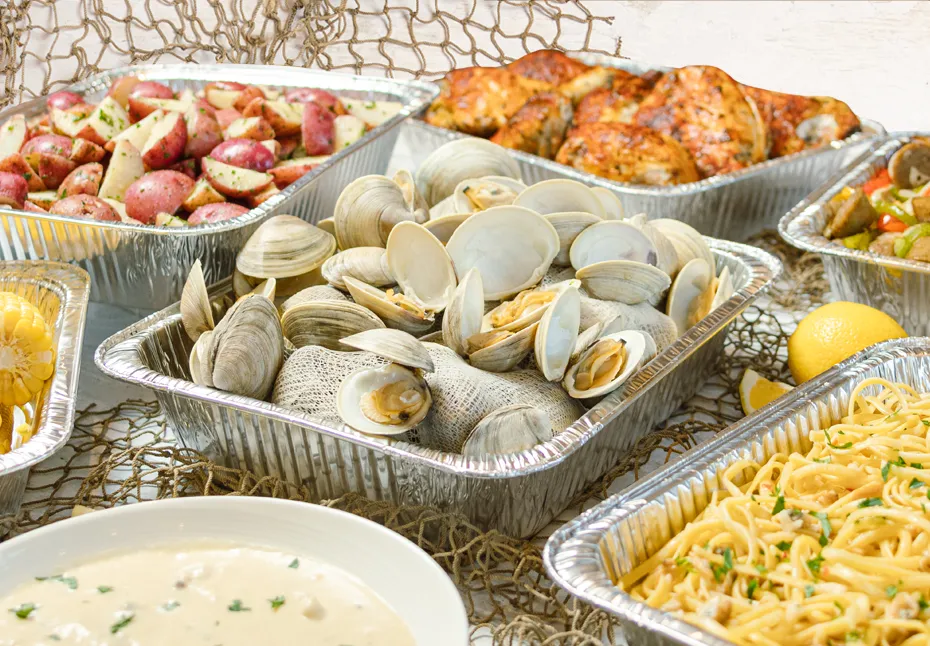
- The Spread: The undisputed heavyweight champion of sheer portions. Alongside the mandatory dozen clams, half-chicken, corn, and chowder, Stancato’s adds fresh linguine with white clam sauce, Italian sausage, and sweet peppers. Arrive hungry, or bring a second vehicle for the take-home boxes.
- 7380 State Rd, Parma • stancatos.com
DIY Kits: Sourcing the Spread at Home
If the backyard fire pit is calling your name, grab a turnkey kit from these local suppliers:
- Euclid Fish Company (Mentor): The clambake standard since 1944. They supply live middlenecks, side dishes, fresh rolls, and will even rent you the massive steamer pots and propane burners. (euclidfish.com)
- Heinen’s Grocery Stores: The hometown grocer’s seafood counter packages foolproof weekend kits with fresh clams, corn, and potatoes. Reserve early, as they routinely sell out during peak October weekends. (heinens.com)
- Stancato’s Catering (Parma): Grab their massive clambake kits to go, complete with sausage, peppers, and clam-sauce linguine for a ready-to-steam home gathering. (stancatos.com)
Brewhoppin: Four Clambake Beer Pairings
While pumpkin spice might dominate supermarket taps, do not let cinnamon and nutmeg anywhere near your steamed shellfish. Nay, you want cheap beer, easy drinking beer, and we’ve got some ideas for you.
| Style | Recommended Pour | Why It Works |
| Local Hero | Great Lakes Brewing Co. – Midwest IPA | Piney hops, grapefruit peel, and clean bitterness slice cleanly through heavy drawn butter and rich clam broth without masking sweet corn. |
| The Authentic | Narragansett | This is what they drink in New England. The real deal. A ‘Gansett has an unpretentious finish meant for standing around a patio burner in your favorite flannel eating shellfish. |
| Bavarian Balance | Market Garden Brewery – Festbier | Toasty bread-crust malt matches roasted chicken skin and hearty chowder, offering subtle sweetness that elevates the bivalves. |
| Why Not Wheat | Fat Head’s Brewery – Goggle Fogger (Hefeweizen) | Gentle clove and banana yeast esters act like a natural culinary seasoning, mimicking the classic white-wine and herb broths of European mussel pots. |
Subscription Box

Eric Gibson is a rabid fan of barbecue, burgers, ramen, and hot chicken. When not eating or playing with his beautiful daughter Aria, he tries to write and edit for Brewhoppin and Vittles&Nosh.